If you have ever dreamed of owning a business that sends you money just for showing up, congratulations. You are already halfway to understanding dividends.
A dividend is a company's way of saying: thanks for being an investor, here is a little something for your trouble.
Some companies pay them. Some don't. Some pay a lot, some pay a little. And some pay regularly enough that you can plan around them.
What a dividend actually is
A slice of a company's profits, handed back to shareholders.
Think of it like a pizza. The company makes the pizza, sells the pizza, and then gives you a slice because you helped buy the oven.
You don't have to do anything special to receive it. You just have to own the stock before a certain date — and that date turns out to be the interesting part.
Six numbers, one screen
Here is the dividend panel for a company on our quote page.
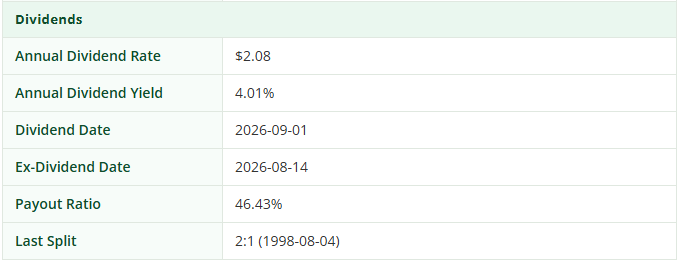
- Annual dividend: $2.08 per share
- Dividend yield: 4.01%
- Payout ratio: 46.43%
- Dividend date: 1 September 2026 — the day the money arrives
- Ex-dividend date: 14 August 2026 — the cutoff to qualify
Those five numbers answer almost every question a new dividend investor has. Let's take them one at a time.
Yield: the "what am I getting?" number
Yield is simply the dividend divided by the share price.
4.01% means that at today's price, $100 invested would produce about $4 a year in cash.
Is that life-changing? No. Is it better than a savings account? Sometimes, sometimes not.
The ex-dividend date, and the thing nobody explains
The ex-dividend date is the cutoff. Own the stock before it and you get this dividend. Buy on or after it and you don't.
Here that date is 14 August. Buy on the 15th and you still own a perfectly good stock, you just don't get paid this round.
It is a bit like showing up late to a cookout. You still get to hang out and have fun. But the burgers are gone.
Now the part that catches people out.
On the morning of the ex-dividend date, the share price will typically open lower by roughly the amount of the dividend. That is not a coincidence and it is not the market being unfair. The company is about to hand out cash, so each share is worth a little less than it was the day before.
Payout ratio: is the dividend safe?
The payout ratio tells you how much of the company's profit is going out as dividends. Here it is 46.43%.
That is healthy. It means the company is paying shareholders some cash AND still keeping more than half its profits to run the business.
A payout ratio near 50% is like someone who pays their bills, adds some money to their 401k or savings account, and still buys the occasional dessert after a night out. It's responsible, but not boring.
What you DON'T want to see is the opposite. A payout ratio pushing past 80%, means the company is paying out most or all of what it earns, maybe even more than it earns. That dividend is being funded by borrowing or by cash reserves, and those are the dividends that will eventually get cut.
What it would actually pay you
Say you own 100 shares.
$2.08
Per share, per year
100
Shares owned
$208
A year, in cash
That is enough for a couple of nice dinners, or one extremely irresponsible Uber Eats order.
Own 1,000 shares and it is $2,080 a year. Now we are talking about real supplemental income, but you would have to have 1000 shares. How much might that expense be?
And if it is held in a regular brokerage account rather than an IRA, dividends are taxable in the year you receive them, whether you spend them or reinvest them.
Why investors like dividend stocks
- Income you don't have to sell anything to collect
- Lower-drama investing
- Something arriving on a schedule you can plan around
- The feeling of running a tiny slice of a giant company
Dividends also soften a downturn. If the share price dips and the company keeps paying, you are still being paid while you wait.
But be careful with the word predictable. A dividend is a decision the board makes every quarter, not a contract. Companies cut dividends, and they cut them in precisely the years you would most like the money, a great many did in 2008 and again in 2020. That is exactly why the payout ratio and the balance sheet matter more than the yield.
The bottom line
Dividends are one of the simplest ways to build wealth slowly. You buy shares, you hold them, and the company pays you for sticking around.
Understand this one screen and you understand almost any dividend.
Now go do it on something you own
Most people have no idea whether the shares sitting in their account pay them anything at all.
- Look up a company you own and find the Dividends panel.
- Write down the yield, the payout ratio and the ex-dividend date.
- Multiply the annual dividend by the number of shares you hold. That is your income from it this year.
- Then ask the real question: is that payout ratio comfortable, or is it stretched?
$0.99 for 14 days, then $24.99/month. Cancel online anytime.
Figures captured in August 2026 and they have moved since. The company shown is a teaching example, not a recommendation. Dividends are declared at the discretion of a company's board and can be reduced or stopped at any time. Dividend income is generally taxable; talk to a tax professional about your own situation.
A lesson, not advice. Companies named are teaching examples, not recommendations. Investing involves risk, including the loss of the money you invest. Full disclosures.