One morning in late July, Apple and Alphabet both traded around $332 a share.
Just twelve cents apart.
If you stopped there, you might assume they were in roughly the same ballpark, as many investors would. They glance at a chart, see a stock price, and quietly decide they've learned something useful.
But perhaps they haven't.
When I ran both companies through our stock evaluator, the results that came back were quite surprising — and that is exactly why this comparison matters. It removes the one thing investors obsess over the most: the price tag.
Do we look at a stock that's $65 and say it's better than a stock that's $45 because it's more expensive? Of course not. So how do we use the stock's price to our advantage?
Here are two simple and effective numbers to compare against the share price: the fair value and the analyst's target price.
Apple: three numbers lead to an unhappy conclusion
$221
Fair Value
$316
Average Analyst Target
$332
Share Price

Apple gets flagged as trading more than 25% above our fair value estimate.
That's financial-model language for:
"Great company. Expensive ticket." Or in plainer terms, you are paying up for the stock.
Alphabet: three numbers and a happier conclusion
$441
Fair Value
$433
Average Analyst Target
$332
Share Price

Here, our fair value model and 51 analysts arrive at almost the same answer.
For Wall Street, that's practically a miracle.
Both estimates sit above the current share price.
Here's the part almost nobody explains
Most investors lump valuations, analyst targets, and stock prices together as if they're all measuring the same thing.
They aren't.
Fair value asks: What is this business actually worth?
Fair value doesn't care what the news said this morning, or what the message boards are doing their best to convince you of. It's the price you'd want to pay if you were trying to get a good deal on the business.
The analyst target asks: Where will the stock price probably be in about a year?
That's a forecast of investor behavior.
Market price asks... nothing.
It's simply the latest number that two people — a buyer and a seller — agreed on.
That's it.
The current market price isn't a divine message from the financial gods. It's the last successful negotiation between a buyer and a seller.
So now we know a little about how to use these three numbers. We'd like to buy a stock trading around its fair value and hopefully under the analyst's average target. Is that enough to go on?
No. Even though it's tempting to feel like we've just discovered some inside knowledge, we still don't know whether the stock we're getting a "deal" on is fundamentally a good stock or a bad one.
What "Bad Stock" actually means
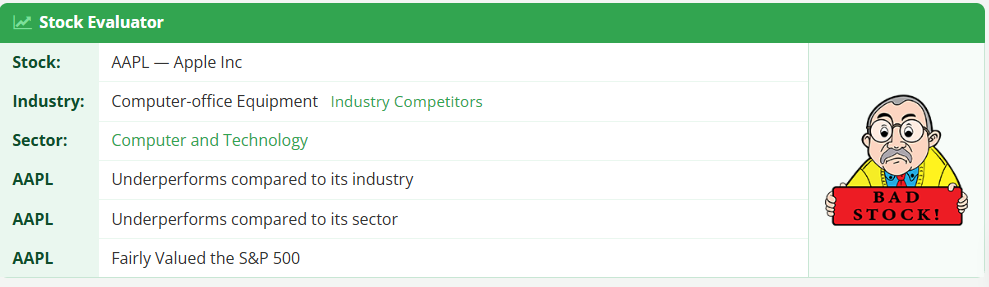
When people see a label like Bad Stock attached to Apple, they tend to react as if someone just insulted their favorite sports team.
Relax.
The score is only grading the company's fundamentals.
Not the chart.
Not the products.
Not Tim Cook.
Not your investment thesis.
Just the numbers.
Those numbers include price-to-earnings, growth, margins, cash flow, debt, profitability.
That's all.
And those numbers aren't telling you to buy or sell anything. They can't. They can only tell you whether the company grades out as good, average or bad on its fundamentals.
Think of it a bit like a home inspection on a house you're thinking of buying. The inspection doesn't tell you to buy the house. It tells you whether the roof is sound, whether the plumbing and electrical are good, whether the foundation is cracked, or whether termites are eating it from the inside out.
Apple can be a phenomenal company that makes great products and still be expensive against its fair value and still score poorly on its fundamentals. Those are three different questions, and all three answers can coexist without causing a tear in the space-time continuum.
Now run the same grading on Alphabet:
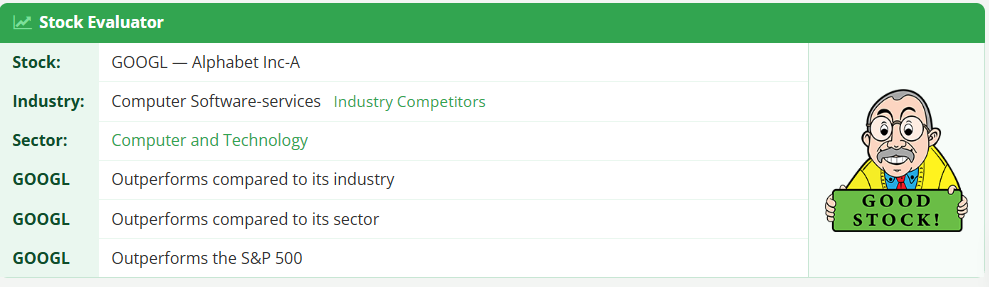
It comes back the other way. On that morning, its fundamentals graded out stronger than Apple's.
So here are two companies at the same share price, and four pieces of information that point in opposite directions. That's a genuinely useful thing to be able to see in ninety seconds — and it is a starting point, not a decision. It says nothing about what either company does next, what you already own, or what you're trying to accomplish. Those parts are yours.
The real questions
When the numbers disagree, as they do with Apple, ask:
What does the market believe that the valuation model doesn't?
Maybe investors expect faster growth.
Maybe they're paying a premium for one of the strongest brands on Earth.
Or maybe the crowd is getting a little carried away.
All three can and do happen.
When the numbers agree, as they do with Alphabet, ask:
What assumption is everyone sharing?
Consensus feels comfortable. When 51 analysts at different firms land in the same place, there's usually something real behind it. It's also worth remembering that markets have a long history of confidently agreeing on the wrong thing, so agreement tells you what the crowd expects — not what will happen.
What matters
You're going to hear people call stocks "cheap" almost every day.
A TV host.
A headline.
A guy at a barbecue who suddenly became a macroeconomist after two beers.
Your job isn't to ask whether a stock is cheap.
Your job is to ask:
Cheap compared to what?
The business?
The forecast?
Last month's price?
Those are three different questions, and they often produce three different answers.
To get those answers, you only need four items:
- The stock's current price
- The fair value
- The analyst's target price
- Whether the stock grades out fundamentally good, average or bad
Ninety seconds, four numbers, and you're asking better questions than most of the people on television.
Takeaway
- Two stocks can trade at the same price and represent completely different situations.
- Fair value estimates business value.
- Analyst targets estimate future stock prices.
- Market price is simply the latest agreement between buyers and sellers.
- "Good Stock" and "Bad Stock" measure fundamentals, not charts, brands, or your decision.
- Most valuation conclusions can be translated into three crucial words:
At today's price.
Now go do it on something you own
Reading about this is fine. Running it on a company you actually hold is what makes it stick, because suddenly the answer matters.
- Open the evaluator and enter a company you own, or one you've been eyeing.
- Write down all four items.
- Are they arguing, like Apple, or nodding along, like Alphabet?
- Then ask the question that fits.
$0.99 for 14 days, then $24.99/month. Cancel online anytime.
Figures captured 30 July 2026 and they've moved since. Apple and Alphabet appear here because everyone recognizes them — nothing above is a view on whether you should own either one.
A lesson, not advice. Companies named are teaching examples, not recommendations. Investing involves risk, including the loss of the money you invest. Full disclosures.