You may already understand covered calls. You've just never had a reason to call them that.
Say you own a car and you're thinking of selling it to buy a new one. It's worth $20,000. Your neighbor likes it and is very interested in buying it. He knows you want to sell, but he isn't ready to buy today. Maybe he can't come up with the $20,000, or he has another bill he wants to pay off first, or perhaps he needs to confirm it with his spouse.
Whatever the reason is, it's really just his reason. But he doesn't want to lose the chance to buy it from you.
So he offers you a deal and hands you $500 in cash right now. In exchange, you agree that any time he's ready over the next three weeks, he can buy the car from you. But you change the price to $21,000, because you might have to wait three weeks before he decides whether he can buy it.
Whether or not he buys the car, you keep the $500. That part is done.
Three things can happen from there, and all three are worth thinking about before you take the money. The price of the car could stay the same, go up, or drop.
- He can't come up with the $21,000, or is unable to buy the car from you. You keep the car and the $500, and now you're free to sell the car to someone else.
- A collector decides your particular model is suddenly worth $26,000. So your neighbor buys it from you for the $21,000 price. You made $1,500 more than your original price of $20,000, but you watched him drive off with a car you might have been able to sell for more.
- The market for that car collapses to $15,000. He walks away. You own a car worth $15,000 and you're holding $500.
That's a covered call. Everything else is vocabulary.
The same deal, in stock language
On the evening of 30 July, Monster Beverage (MNST) closed at $97.65.
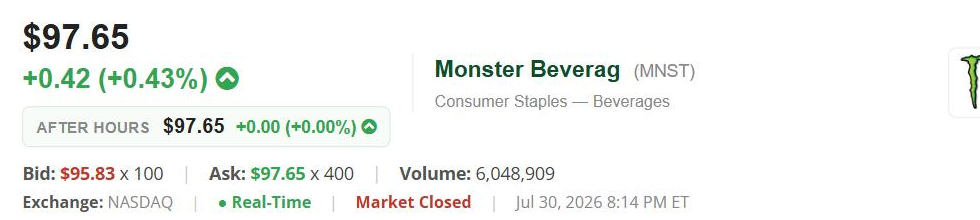
If you owned 100 shares of this stock, you'd have $9,765 sitting there. Sometimes it goes up, sometimes it goes sideways, and sometimes it drops. An investor looking to make some extra money on stock they already own might decide to do a covered call.
Unlike the car example above, when it comes to collecting a cash payment on stock you own, you don't need to go out and find a buyer. They're already listed.
Below are the call premiums — the amount someone is willing to pay you today for the right to buy your stock in the future. This is the call side of the option chain for Monster Beverage.
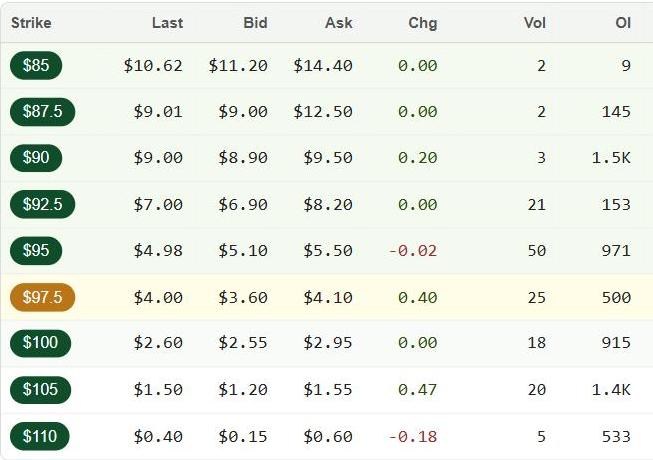
This example was taken on 30 July 2026 for the expiration date of 21 August 2026, about 22 days away. That sounds like a mouthful, but it really just means someone wants the right to buy your stock before the market closes on 21 August.
For this example there are really just two columns you're interested in: the Strike and the Bid. The Strike is the price someone wants to buy the stock from you at. The Bid is how much they're willing to pay you today for the right to buy at that strike price.
So if you own MNST and you would not mind selling it any time in the next 22 days for $100 a share, then someone is telling you they will give you $2.55 per share, in cash today, for each share you own. That's $255 for every 100 shares. If you had 400 shares, that's an extra $1,020 in cash for 22 days.
Now, before you start thinking you've hit the holy grail of investing and you're going in on Monday to quit your job, there are three things you need to know and remember.
- You need to own 100 shares to do a covered call. Or 200, or 300. So if you have 98 shares, you might want to buy 2 more.
- The stock could drop in value, so you'll want to make sure the stock you own is really a stock you want to own regardless of the current price.
- The stock could go up in value and you might still have to sell it for $100. You need to be OK with that.
That's it. That's the trade.
What the $255 actually buys
Twenty-two days. You promised to give someone 22 days to make up their mind about buying your stock.
On $9,765 of stock, $255 is about 2.6% for simply agreeing to a sale price for the next three weeks.
Which sounds excellent, right up until you ask the question almost nobody asks.
What are you giving up?
Three weeks from now, one of three things has to happen.
First — Monster is at $98. The buyer decides not to buy the stock from you. You keep your shares and you keep the $255. This is the outcome people picture when they hear about covered calls, and it does happen a lot.
Second — Monster is at $104. Your shares get sold at $100 whether you like it or not. You made $235 on the stock plus $255 in option premium: $490.
Had you done nothing at all, you'd have $635. In this scenario it is oh so easy to look back and coulda, woulda, shoulda.
So the $255 cost you $145 and your shares. That is the part of the covered call sales pitch that everyone leaves out, and it is not really a disaster. It's just the price of the deal you made.
Third — Monster is at $90. No one buys your stock at $100. You still own the shares, now worth $9,000, but you have an extra $255 of cash in your account.
You're down $765 on the shares and holding $255, so you're out $510 on the day. The premium softened it. It did not stop it.
What if I don't really want to sell my stock?
Look back at that option chain for MNST and read it as a sort of ladder.
- Promise to sell at $97.50 — about $3.60 a share
- Promise to sell at $100 — about $2.55
- Promise to sell at $105 — about $1.20
- Promise to sell at $110 — about $0.15
Nobody set those numbers by hand. You're being paid for the odds.
Promising to sell at $105 is much safer than promising to sell at $100, because Monster probably isn't getting to $105 in three weeks. The reason you only receive $1.20 instead of $2.55 is that investors are less convinced the stock will actually make it to $105 in 22 days.
So the real question for you is this. Are you OK getting paid $2.55 per share to potentially sell your stock at $100? Or are you OK getting paid $1.20 per share to potentially sell your stock at $105?
In other lessons in the members' area we cover some of the techniques investors use to reduce the chance of having their stock called away while still keeping the option cash.
Here's the best part — where the best covered call candidates come from
Our Covered Call screen does the finding-out in just a few seconds. It runs each day after the market closes and lines up companies that pass our fundamental grading and are currently in an uptrend. It then displays the two closest strike prices and the bid price for each one. That makes finding a potential covered call candidate a very simple process.
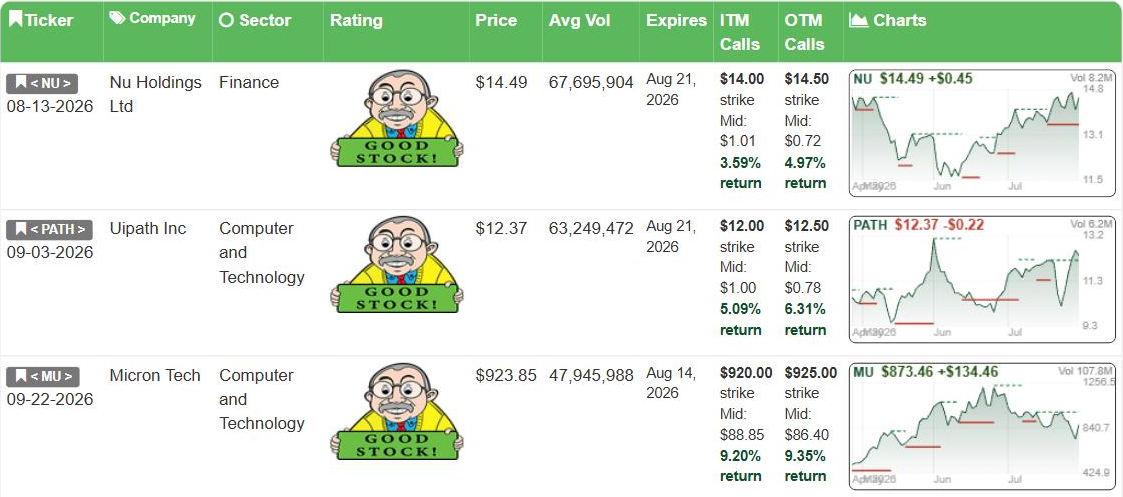
Two things to be clear about, because they matter more than the returns column.
The Good Stock rating is grading the company's fundamentals — earnings, margins, debt, cash flow. Not the chart, not their products, not whether the stock is going up next week.
And the return percentage is what you'd collect if the trade goes the boring way. It is not a forecast, it isn't annualized, and it says nothing about what happens to the shares underneath.
The question to ask before you ever sell one
Not "how much will I collect?"
"Would I be happy to sell these shares at that price?"
If the honest answer is yes, the premium is a bonus on a sale you were already willing to make.
If the honest answer is no — if you'd be irritated to lose them at $100 — then you're being paid $255 to do something you don't want to do. Some people take that deal anyway. They should at least know that's the deal they're taking.
Takeaway
- A covered call is a paid promise to sell shares you already own, at a set price, by a set date.
- The cash is yours immediately and you keep it in every outcome.
- What you are giving up is your upside above the strike price.
- The premium, $2.55 per share, cushions a fall if the stock drops. It does not prevent one.
- Closer strike prices pay more but get called away more often. Further strikes pay less and leave more room for you to sell higher or keep your stock.
- The only question that matters comes before the money:
Would I be happy to collect this much money to sell my stock at that price?
Now go do it on something you own
This stops being theory the moment the shares are yours.
- Pull up a company you own 100 or more shares of.
- Open the option chain and find the expiration three or four weeks out.
- Pick a strike price you'd be content to sell at, and multiply the bid by 100.
- Now ask yourself whether you'd take that much to give up everything above it.
Get access to the chain and the screen
$0.99 for 14 days, then $24.99/month. Cancel online anytime.
Prices captured after the close on 30 July 2026 and they have moved since. Monster Beverage appears here because it happened to sit near a round number that makes the arithmetic easy to follow — nothing above is a view on whether you should own it, or sell calls against it. Options are not suitable for every investor, and a covered call can result in your shares being sold below the market price.
A lesson, not advice. Companies named are teaching examples, not recommendations. Investing involves risk, including the loss of the money you invest. Full disclosures.